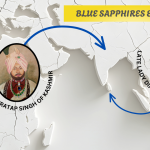
Throughout history, sapphires have occupied a special place among gemstones, admired not only for their durability but also for their remarkable beauty. When lists are compiled of the most famous sapphires ever discovered or worn, a clear pattern emerges. Names such as the Zanskar Crown Sapphire, the blue sapphire in the engagement ring of Princess Diana, and the Spirit Of Kashmir Sapphire all share a defining trait: they are blue. This repeated prominence of blue stones is not accidental but reflects centuries of cultural preference, historical availability, and early gemological assumptions.
SCIENCE REVEALS SAPPHIRE COLORS
Modern science has established that sapphires occur in a wide spectrum of colors. Mineralogically, sapphire is the gem variety of corundum, and trace elements such as iron, titanium, chromium, and vanadium determine its color. As a result, sapphires can be colorless, pink, purple, green, yellow, orange, or blue. Yet for much of recorded history, the word “sapphire” was virtually synonymous with blue. This long-standing association shaped collecting habits, royal traditions, and even the language of gem trading.
CEYLON AND KASHMIR
One reason for this historical bias was geographical. Some of the earliest and most celebrated sapphire sources produced stones predominantly in blue hues. The famed mines of Kashmir, discovered in the late nineteenth century, yielded sapphires with a velvety, cornflower-blue color that quickly became the benchmark for quality. These gems displayed a soft internal glow caused by microscopic inclusions that diffused light, creating what connoisseurs still describe as a “sleepy” or “silk” effect. Because the Kashmir deposits were limited and eventually exhausted, stones from this region became rare and highly coveted, reinforcing the idea that true sapphires were blue.
Another historic source that strengthened this perception was Sri Lanka, long known in the gem trade as Ceylon. For centuries, traders exported sapphires from this island to markets across Asia, the Middle East, and Europe. Although Sri Lanka actually produces sapphires in many colors, blue stones were the most frequently traded and most strongly promoted. Their consistent supply ensured that jewelers and royal patrons alike associated the gemstone primarily with blue brilliance.
FAMED BLUE SAPPHIRES
The sapphires mentioned in the brief each illustrate different facets of this tradition. The Zanskar Crown Sapphire is reputed for its deep royal blue tone and its association with ceremonial regalia, symbolizing authority and prestige. This big cushion cut Kashmir sapphire, was reportedly worn by Maharaja Pratap Singh of Kashmir, in a royal necklace. Interestingly multiple online sources claim that, the Maharaja sold the Zanskar Crown Sapphire, to create funds for his ambitious projects aimed at developing Kashmir and Kashmiris.
The sapphire in Princess Diana’s engagement ring, now worn by Catherine, Princess of Wales, is a 12-carat oval blue stone surrounded by diamonds. Its visibility in photographs, films, and public appearances made it one of the most recognizable gemstones in the world, further cementing the public’s mental link between sapphires and blue coloration. After the death of Princess Diana in 1997, her iconic blue sapphire engagement ring was inherited by her sons. It was eventually given to Prince William, who used it in 2010 to propose to Catherine, Princess of Wales. Online sources clarify that, the lady Diana’s sapphire ring was dismantled, the Ceylon sapphire was used to craft the engagement ring gifted by Prince William.
The Spirit Of Kashmir Sapphire, another celebrated stone, is admired for its saturated yet soft blue color characteristic of top Kashmir material and is often cited by collectors as an example of ideal hue and clarity. While this Kashmir sapphire was submitted to the Guinness team, to get a listing on the famed portal of world records, details of ownership and official certifications were not revealed as general information.
Beyond these, numerous other historic sapphires reinforce the same pattern. The Star of India, housed at the American Museum of Natural History, is one of the largest known star sapphires, weighing over 560 carats and displaying a pale blue tone with a distinct six-rayed star. The Logan Sapphire, displayed at the Smithsonian Institution, is a 423-carat cushion-cut gem of rich blue color, considered one of the finest faceted sapphires ever discovered. The Stuart Sapphire and St Edward’s Sapphire, both part of the British Crown Jewels, are steeped in royal history and likewise exhibit blue coloration. Even the Rockefeller Sapphire, famous for its record-setting auction price, is remembered for its vivid blue hue.
HISTORIC SYMBOLISM OF BLUE SAPPHIRES
Historically, color symbolism also played a role in elevating blue sapphires above all others. In many cultures, blue represented heaven, truth, loyalty, and divine favor. Clergy in medieval Europe wore blue sapphires to symbolize purity and wisdom, while monarchs prized them as talismans of protection and legitimacy. Because these symbolic meanings were tied specifically to blue, other sapphire colors never achieved equal prominence, even when they were equally rare or beautiful.
LIMITATION IN GEM CLASSIFICATION
Another factor was early gem classification. Before the development of modern mineralogy in the eighteenth and nineteenth centuries, gemstones were often categorized primarily by color rather than chemical composition. Blue transparent stones were frequently labeled “sapphires,” while stones of other colors might be mistaken for entirely different gems. Pink sapphires, for instance, were sometimes called rubies, and yellow sapphires could be confused with topaz. Only with advances in scientific analysis did gemologists confirm that all these stones belonged to the same mineral family. By then, centuries of linguistic habit had already cemented the association of sapphire with blue.
MARKET PUSHES BLUE SAPPHIRES
Market forces further reinforced this tradition. Jewelers and traders discovered that blue sapphires consistently commanded higher prices and stronger demand than other colors. As a result, they promoted blue stones more heavily in advertising and royal commissions. This commercial emphasis meant that collectors, museums, and historians recorded and publicized blue sapphires more often, creating a feedback loop in which the most famous examples were almost always blue.
Despite this long history, appreciation for non-blue sapphires has grown significantly in recent decades. Improved gemological education and changing fashion tastes have encouraged collectors to explore the full palette of sapphire colors. Fancy sapphires in pink, orange, or green are now highly sought after, and rare padparadscha sapphires—displaying a delicate blend of pink and orange—can rival fine blue stones in value. Nevertheless, the cultural image of sapphire remains overwhelmingly tied to blue, a testament to centuries of tradition.
QUICK SUMMARY
In conclusion, the dominance of blue sapphires in historical fame is not due to nature limiting the gem to one color. Rather, it results from a combination of geological happenstance, early trade patterns, cultural symbolism, and long-standing assumptions. From the storied mines of Kashmir to the gem gravels of Sri Lanka, the most visible and celebrated stones happened to be blue, shaping public perception for generations. Even today, when science clearly shows that sapphires occur in many hues, the legendary status of stones like the Zanskar Crown Sapphire, the sapphire of Princess Diana’s ring, and the Spirit Of Kashmir Sapphire ensures that blue, remains the color most people imagine when they hear the word “sapphire.”